
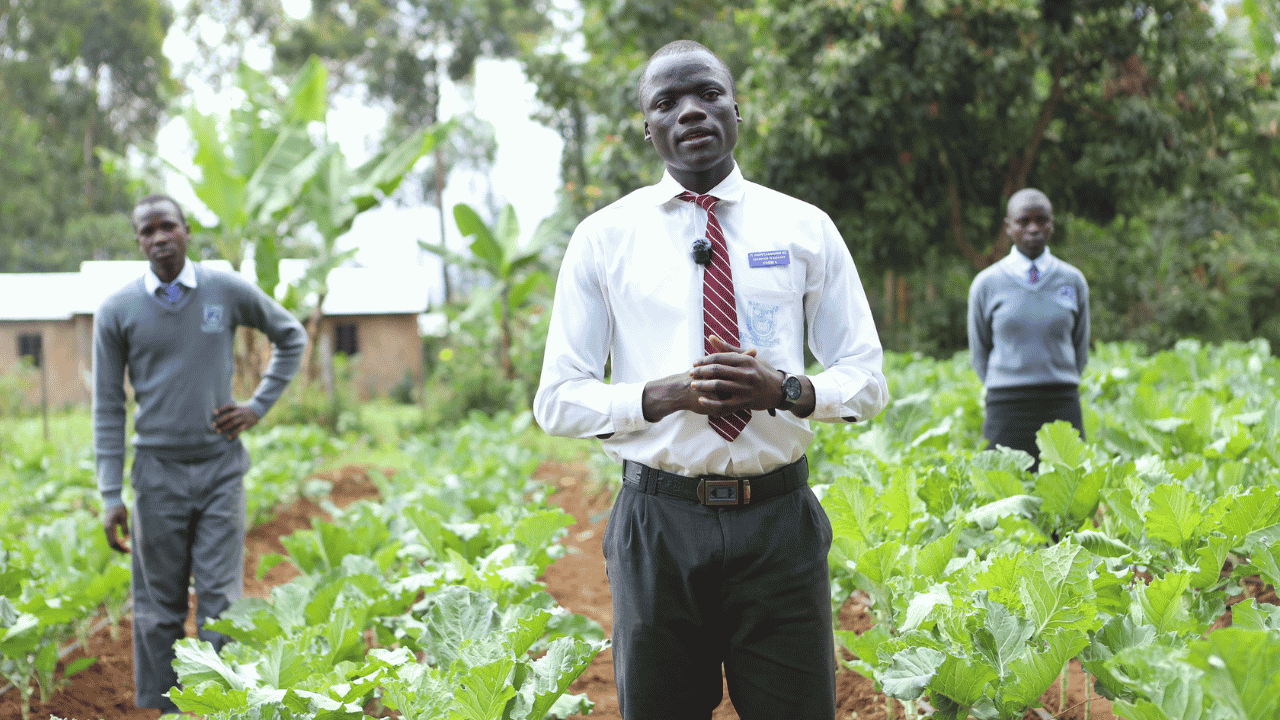
In many rural communities across Kenya, young people are often viewed as the future of agriculture. At St. Joseph’s Kamusinde School in Bungoma County, however, learners are proving that they can also shape the present. With a school population of 570 learners, St. Joseph’s Kamusinde has become a center of agricultural learning where students are not only acquiring knowledge but also putting it into practice through the school’s active 4K Club. Supported by ADS Western and its partners, the club helps learners develop practical skills in agroecology and regenerative agriculture while nurturing leadership, innovation, and environmental responsibility.
For years, farming has struggled to attract young people, partly due to the perception that it is labor-intensive and offers limited opportunities. Yet at St. Joseph’s Kamusinde, a different narrative is emerging. Learners are discovering that agriculture is not merely about growing crops; it is about solving problems, conserving resources, and building resilient communities.
Dominick Simiyu Wekesa, Chairperson of the school’s 4K Club, he has witnessed how practical agricultural activities have sparked interest among learners who previously had little enthusiasm for farming. “The club has given us an opportunity to learn by doing,” says Dominick. “We are learning how healthy soils, good farming practices, and environmental conservation are connected. Agriculture is no longer something we only read about in books. We can see the results for ourselves.”
Under the club’s activities, learners have been introduced to practices such as compost making, mulching, crop diversification, and soil conservation. These methods form part of regenerative agriculture, an approach that seeks to restore soil health, improve biodiversity, and strengthen resilience against climate change.
For Elizabeth Nasimiyu, a member of the 4K Club, the lessons learned have become valuable tools she can apply at home and share with others. “Through the club, I have learned how to improve soil fertility using locally available materials instead of relying entirely on purchased inputs,” she explains. “I have shared some of these practices with my family, and they are beginning to understand the benefits of sustainable farming.”
Her experience reflects one of the key strengths of the 4K Club model: learners become ambassadors of knowledge within their households and communities. By transferring practical skills to parents, siblings, and neighbors, they help accelerate the adoption of sustainable agricultural practices beyond the school environment.
According to 4K Club Patron Alfred Wafula Mulongo, this ripple effect is exactly what makes school-based agricultural programs so powerful.
“When learners understand why they should protect the soil, conserve water, and diversify crops, they carry that knowledge home,” he says. “The result is that schools become centers of innovation where ideas can spread into the wider community.”
Mr. Mulongo notes that the partnership with ADS Western has strengthened the school’s ability to provide practical agricultural training. Through demonstration plots and hands-on learning sessions, learners have gained exposure to agroecological principles that promote sustainable food production while safeguarding natural resources.
As climate change continues to challenge agricultural systems across Kenya, the need for resilient farming approaches has never been greater. Agroecology offers a pathway that combines scientific knowledge with locally adapted practices, enabling farmers to produce food while maintaining healthy ecosystems.
At St. Joseph’s Kamusinde, learners are embracing this approach with enthusiasm. They are learning that every healthy crop begins with healthy soil and that every farming decision has an impact on the environment. More importantly, they are discovering that they have a role to play in shaping the future of food systems.
By equipping young people with practical skills, leadership opportunities, and a deeper understanding of regenerative agriculture, the school is preparing a generation capable of addressing some of the most pressing challenges facing agriculture today.


